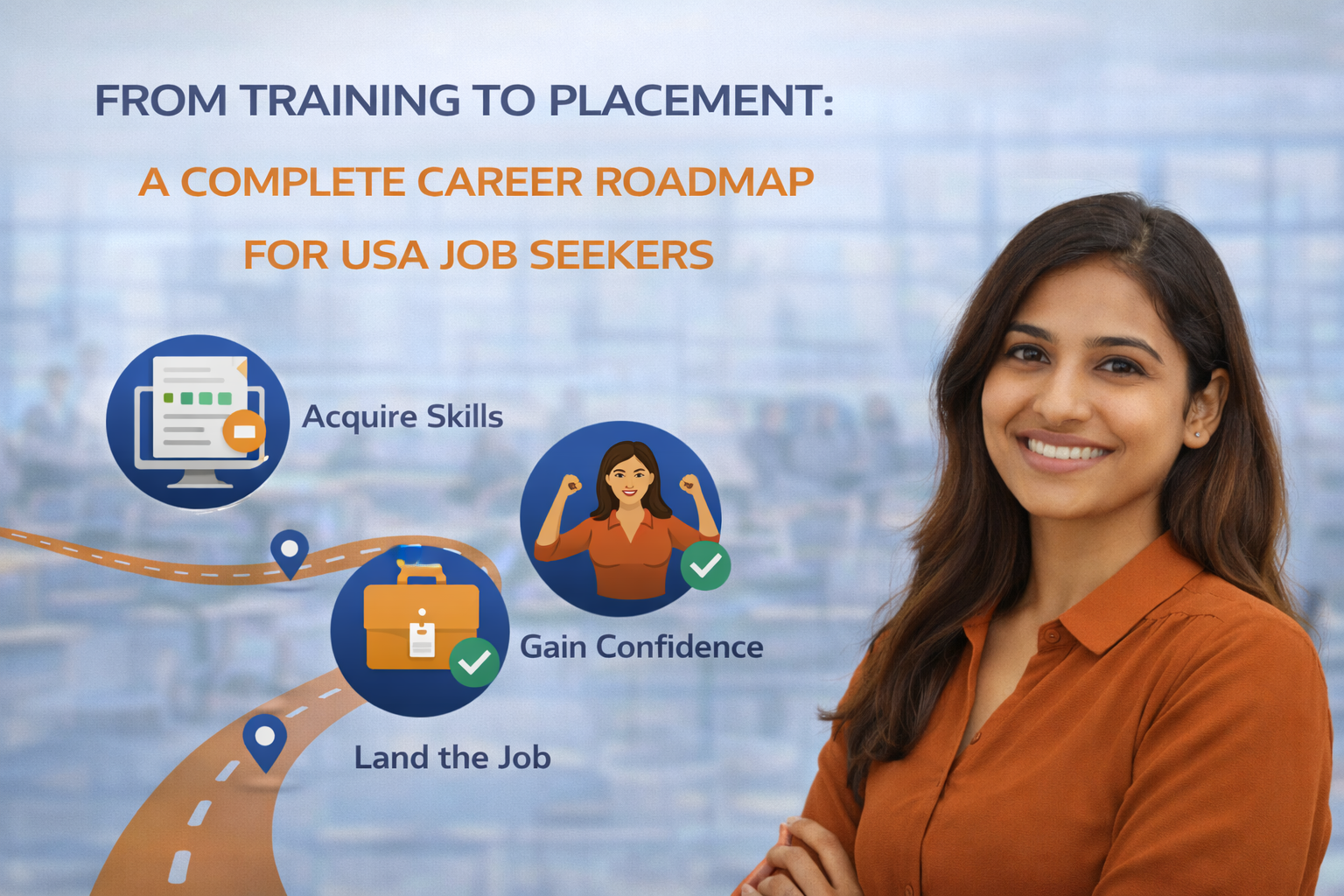
From Training to Placement: A Complete Career Roadmap for USA Job Seekers
In 2026, the US job market has moved past the "Great Resignation" and into the "Great Skill-Up." With AI and automation now embedded in every industry—from healthcare in Nashville to fintech in Charlotte—the journey from student to employee requires a more strategic, tech-enabled approach than ever before.
Whether you are a fresh graduate or a career changer, here is your 4-stage roadmap to landing a job in the USA.
Stage 1: The "Skills-First" Training Phase
In 2026, many US employers have removed degree requirements in favor of Verified Skills. Your training must focus on "Market Fit" rather than just general knowledge.
- Identify Your "Core Lane": Choose a high-growth sector. Currently, the most in-demand lanes in the USA are AI Implementation, Cybersecurity, Cloud Architecture, and Sustainability (ESG) Strategy.
- The 2026 Certification Stack: Don't just get one; "stack" them.
- Example: Pair an AWS Cloud Practitioner cert with a CompTIA Security+ to become a high-value Cloud Security candidate.
- AI Literacy: Regardless of your field, you must be trained in using AI agents (like Gemini or specialized LLMs) to automate your specific workflow.
Stage 2: Building a "Proof of Work" Portfolio
In the USA, "show, don't tell" is the gold standard for 2026.
- GitHub/Portfolio for Everything: If you’re a developer, your GitHub should show active commits. If you're in Marketing or HR, your portfolio should show case studies of AI-driven projects or efficiency gains.
- Contribute to Open Source or Local Non-Profits: US recruiters look for "Real-World Impact." Volunteering your tech skills for a US-based non-profit is a top-tier resume booster.
Stage 3: The Optimized Job Search (Avoiding the "Black Hole")
The "Spray and Pray" method of applying to 100 jobs a day is dead. In 2026, Precision Hiring is the rule.
- Master the "Agentic ATS": Modern Applicant Tracking Systems (ATS) use AI to "read" your career trajectory. Ensure your resume highlights Outcomes (e.g., "Increased Q3 revenue by 12%") rather than just tasks.
- The 24-Hour Rule: Apply to roles within 24 to 48 hours of them being posted. In 2026, the first 50 qualified applicants often fill the interview quota.
- LinkedIn Entity Trust: Ensure your LinkedIn profile is an exact mirror of your resume. AI recruiters cross-reference these to verify your "Trust Score."
Stage 4: The Strategic Placement Phase
Getting the interview is Stage 3; winning the offer is Stage 4.
- Virtual Interview "Aura": With hybrid work being the US standard, your virtual interview setup (lighting, audio, background) is viewed as a reflection of your professional "digital hygiene."
- The "Referral Fast-Track": 70% of US jobs are filled through referrals. Before applying, find a contact at the company. A simple, "I’m applying for the [Role], would you be open to a quick chat?" can bypass the AI filters entirely.
- Negotiating "Total Comp": In 2026, US offers are more than just salary. Negotiate for AI training stipends, home-office budgets, and flexible hybrid schedules.
2026 Career Roadmap Summary
| Step | Focus Area | Goal |
|---|---|---|
| 01. Training | Certifications & AI Literacy | Build a "Skills-First" foundation. |
| 02. Evidence | Portfolio & Real-World Projects | Create "Proof of Work." |
| 03. Application | ATS Optimization & Referrals | Get past the AI gatekeepers. |
| 04. Placement | Interview Prep & Negotiation | Land the offer and maximize "Total Comp." |
FAQ: Navigating the 2026 US Market
Q: Which US cities have the most job openings in 2026?
Ans: While Austin and Seattle remain tech leaders, "Emerging Hubs" like Columbus, Ohio (Intel/Tech) and Raleigh-Durham (Biotech) are seeing the highest growth in 2026 due to a lower cost of living.
Q: Is it worth getting a PMP (Project Management Professional) in 2026?
Ans: Yes. The PMP remains the "Gold Standard" for leadership roles in the USA, especially as companies need humans to manage complex AI-integrated projects.
Q: How do I handle the "Background Check" in the USA?
Ans: In 2026, US law usually requires a Conditional Offer first. Be transparent during the "Individualized Assessment" if you have any gaps or records.
Final Tip: The "Trajectory" Factor
US recruiters in 2026 aren't just hiring for what you know today—they are hiring for your Trajectory. Show them you are a "Life-Long Learner" by mentioning the specific skills you are currently studying.
Interviews
Candidates
Courses
Trainers